Academic productions
ICML 2020Smart Sensor Calibration with Auto-Rotating Perceptrons
Daniel Saromo, Leonardo Bravo, and Elizabeth Villota
Research Paper - LXAI ICML 2020
July 13th, 2020 - Vienna, Austria
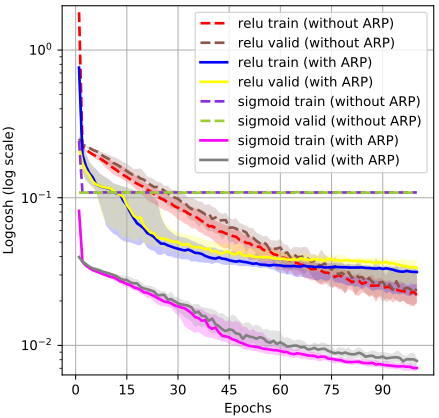
Sensor calibration is vital to have valid measurements of physical activities. In this paper, we deal with adjusting the signal from a wearable force sensor against a reference scale. By using a few samples and data augmentation, we trained a neural-based regression model to correct the wearable output. For this task, we tested the novel Auto-Rotating Perceptrons (ARP). We found that a neural ARP model with sigmoid activations can outperform an identical neural network based on classic perceptrons with sigmoid and even ReLU activation.
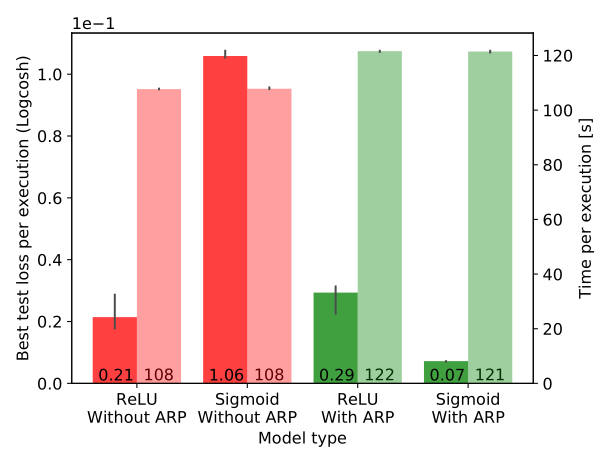
When changing classic perceptrons to ARP, the test loss of the sigmoid networks was reduced by a factor of 15 at the cost of increasing the execution time by ∼12% (see bar graph below).
Work presented as an oral exposition and poster session at the LatinX in AI Workshop co-located with ICML 2020.
Erratum: In the oral presentation video, when I say “without learning the inference structure of the perceptron”, I mean “without altering the inference structure learned by the perceptron”.
Publication resources